The Verona Civic Library has always collected documents, manuscripts and books useful for telling the history of the city and its territory. From some traces it is sometimes possible to reconstruct the provenance of these documents, once produced, preserved or reused in archives or libraries of ancient religious bodies and noble families, deposited here following suppressions of the same bodies or arriving by donation or purchase.
For example, from short notes or signatures that report the original location of the volume in which the document was reused it is possible to reconstruct its path, as can be seen in the case of a passion book reused to create the cover of an incunabulum in the library of the Marquis Paolino Gianfilippi or in the fragment of a biblical text (Epistolae), used to cover a register of imbreviatures in the archive of the monastery of Santa Maria in Organo. In other cases, however, it is the content of the document itself that gives us probable indications of its origin, such as the parchment which contains some testimonies given during a trial in which the monastery of San Zeno was involved.
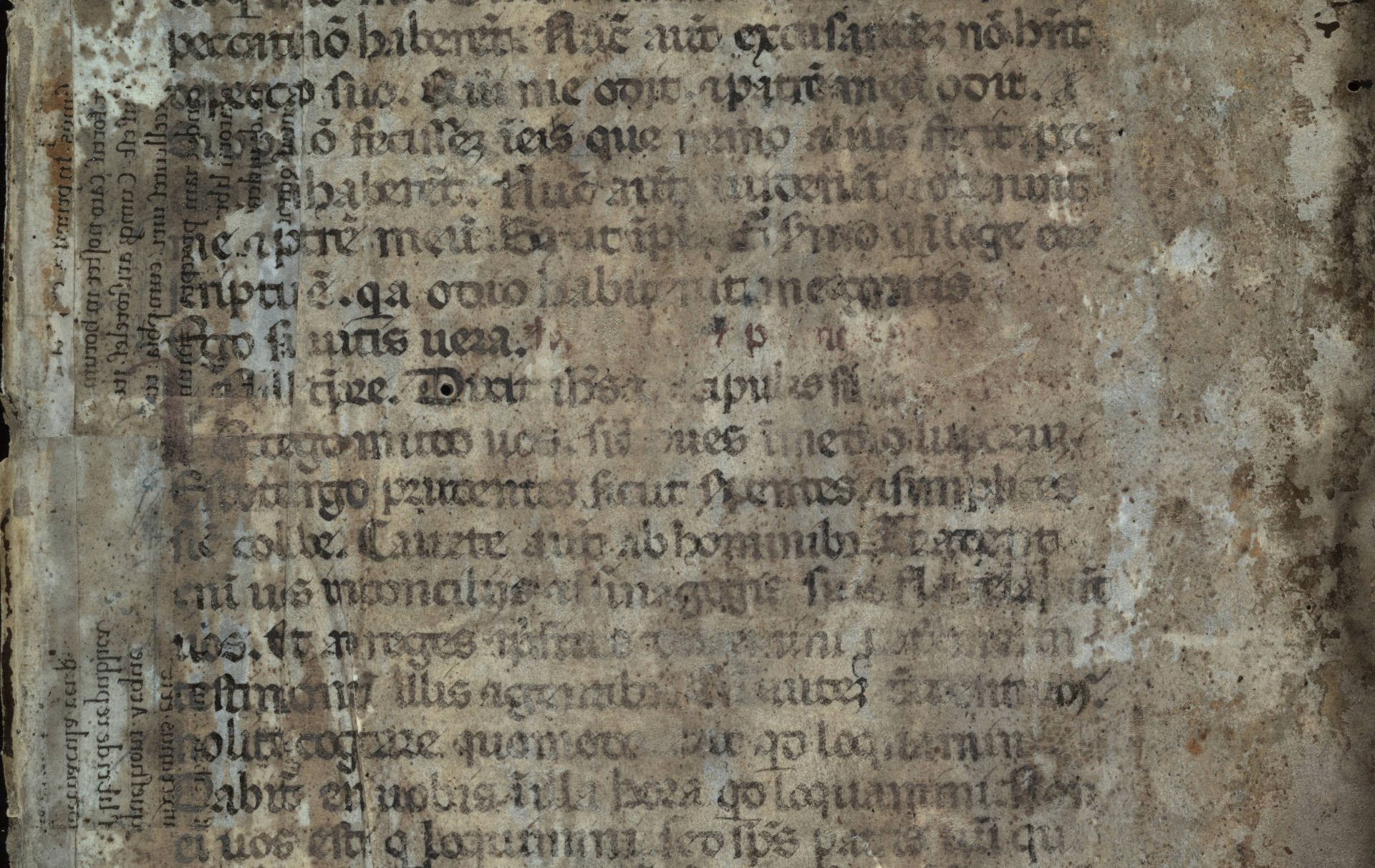
The fragment, made up of a single card, contains some passions, or the narration of the sufferings suffered by the saints: the final part of the Passio Sancte Theclae (BHL ns 8020-8025) and the incipit of the Passio sanctorum Iustine et Cipriani et Theogniti mar( tyris) (BHL ns 2047 and 2048b). Since these are saints celebrated in the calendar on 23 and 26 September respectively, it is assumed that it was a passionary ordered according to this sequence.
The inscriptions placed in the space intended for the spine of the volume inform us that this code fragment was reused to create the cover of a work by Bernardino de’ Busti published in Milan in 1492, which can be recognized in the Officium immaculate Conceptionis gloriose virginis Marie , printed precisely on that date by the Milanese printer Ulderico Scinzenzeler. By associating this information with the numbers 34 and 291 which can be read in the same position on the parchment, this incunabulum can be identified as that of the library of the Marquis Paolino Gianfilippi, acquired by the Municipality of Verona in 1847 for the Civic Library, where it is currently preserved. These two figures correspond in fact to the original location of the volume in the Gianfilippi library, which we find reported in an annotation on the original endpapers (c. IIv: «P / Scanzia IV / Number 34»), and to the chain number of the inventory of the same library, built at the beginning of the 19th century (ms 3198.2, Editiones saec. estimate of 6 lire.
Fragment of the New Testament or of a liturgical text with the first epistle of Saint Paul to the Corinthians. Since the text is not continuous (it reports the epistle from 6.2 to 7.14 and from 9.25 to 11.5), it must be assumed that this quatern contained another missing one.
The codex fragment comes from the monastery of Santa Maria in Organo, where it had been reused as a cover for a book of imbreviatures (i.e. minutes of notarial deeds) dated to 1390. It was recognized and removed from this location probably at the end of the 19th or in the beginning of the 20th century, when the monastery archive was preserved in the Ancient Veronese Archives annexed to the Civic Library, as a pencil annotation reports: “Santa Maria in Organo, Liber imbreviaturarum 1390”.
FRMVxx obj03A
FRMVxx obj03B